Follow the patient, win the deal: 4 ways longitudinal patient data gives MedTech reps a commercial edge
Longitudinal patient data traces an individual patient's healthcare journey over time — from initial diagnosis through treatment, outcomes, and follow-on care. Unlike encounter-level data, which captures a single interaction, longitudinal data reveals the full arc of a patient's path: where they enter the system, where they go for treatment, what happens after the procedure, and who influenced their care along the way.
June 2, 2026
How longitudinal patient data uncovers market intelligence beyond procedure volume
Most MedTech reps know who performs the highest procedure volumes in their territory. What they often can’t see is everything that happens before and after the procedure: where patients first enter the system, who diagnoses them, whether they stay in-network for treatment or seek subsequent care elsewhere, what outcomes they experience, and who ultimately influences their care path.
That blind spot is the difference between encounter-level data and longitudinal patient data, and it’s where many valuable commercial conversations are happening.
Encounter-level targeting is a scalpel for MedTech reps: precise, focused, and essential for identifying and prioritizing the right targets. Longitudinal patient data is broader — like a Swiss Army knife of insights. It traces patient healthcare journeys over time and can reveal patterns and opportunities. Having longitudinal data doesn’t replace precision targeting, but rather expands it. And when used well, it turns good reps into strategic partners. It’s also the foundation for real-world evidence — the kind of outcomes data that increasingly drives purchasing decisions in a value-based care environment.
Here are four insights that only longitudinal data can unlock, and why they matter commercially for MedTech reps moving from reactive targeting to proactive market intelligence.
Insight #1: Where are patients leaking, and why?
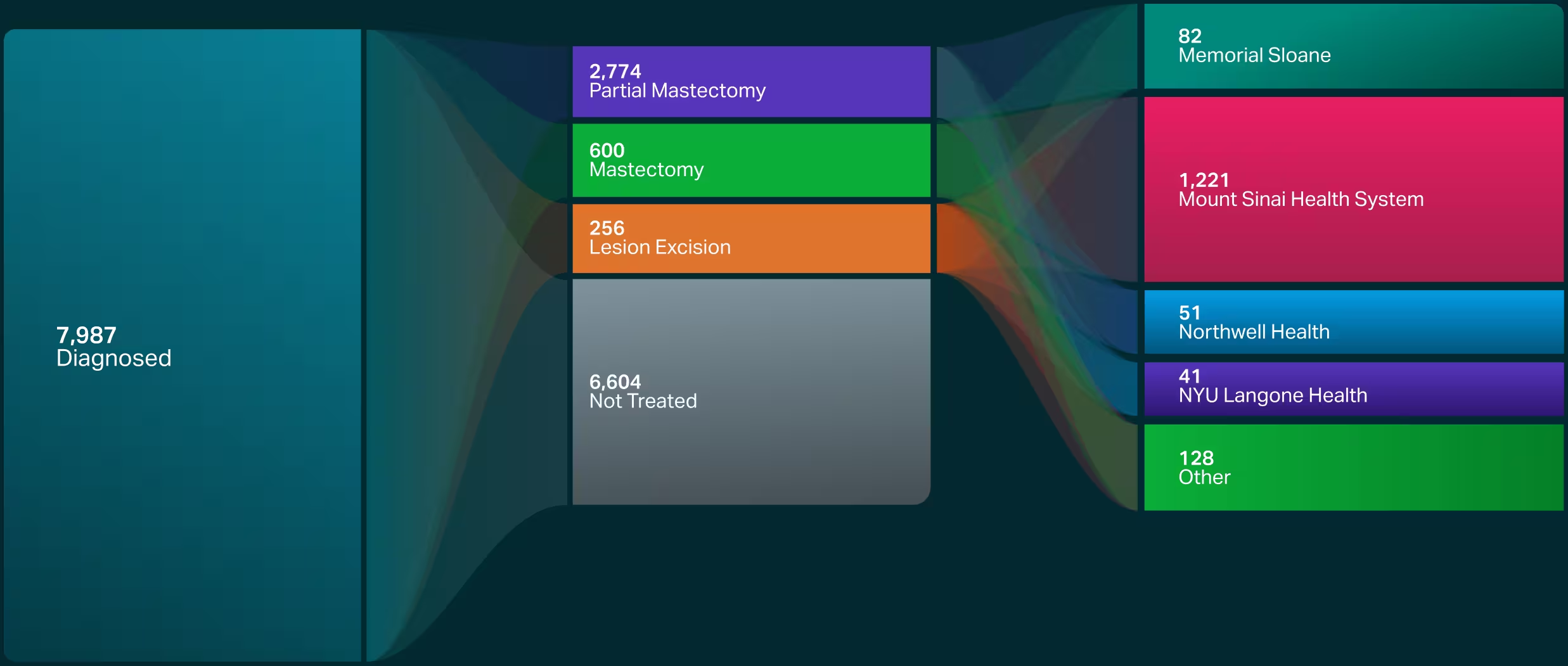
A hospital treating 1,000 newly diagnosed patients a year looks like a strong target—until you realize that 600 of those patients leave for treatment at a competing health system.
That’s patient leakage and historically, it’s been difficult to quantify. Longitudinal data changes that by following patients from diagnosis to treatment, revealing how many leave, where they go, and what care they ultimately receive.
This reframes the conversation with a site administrator entirely. Instead of focusing on current procedure volume, reps can quantify lost revenue and connect it to potential clinical or operational gaps. For health systems under financial pressure, that creates a far more urgent and actionable conversation centered on business impact.
The same lens also strengthens retention conversations. Are patients treated with your product more likely to stay in-system? Do they return for follow-on care? When you can measure that, you move from product value to system-level ROI.
Insight #2: How many patients are diagnosed, but never treated?
Even in sites or systems with strong retention, a significant portion of diagnosed patients never receive procedural treatment. They appear in the data with the right diagnosis codes, but remain untreated, often managed conservatively or asked to wait.
Longitudinal data makes this gap visible through intervention rates. If thousands of patients are diagnosed annually but only a fraction receive treatment, it highlights a sizable, underserved population.
For MedTech companies, especially those offering earlier-stage or less invasive solutions, this visibility is powerful. Reps can quantify the size of the untreated population and model what even modest increases in intervention could mean for both patient outcomes and system revenue. This shifts the conversation from theoretical value to measurable impact.
When executed well, it creates alignment across stakeholders: patients gain access to appropriate care sooner, providers expand their impact, and MedTech companies grow through clinically meaningful adoption.
Insight #3: What do patient outcomes look like after the procedure?
The patient journey doesn’t end at treatment, and neither should the data.
Longitudinal datasets track what happens next: complications, readmissions, infections, and retreatments. This makes it possible to evaluate outcomes at the site level and compare them to benchmarks or peer institutions.
For clinically driven stakeholders, this is often the most compelling evidence. Real-world outcomes data, drawn from large, diverse patient populations provide a more practical view of performance than controlled studies alone. It also sharpens targeting. Sites with higher-than-average complication rates become clear opportunities for engagement, while high-performing accounts become credible proof points.
For any product with a clinical value story, whether tied to safety, durability, or recovery, this is what makes that story tangible.
Insight #4: What is the referral whitespace around this HCP?
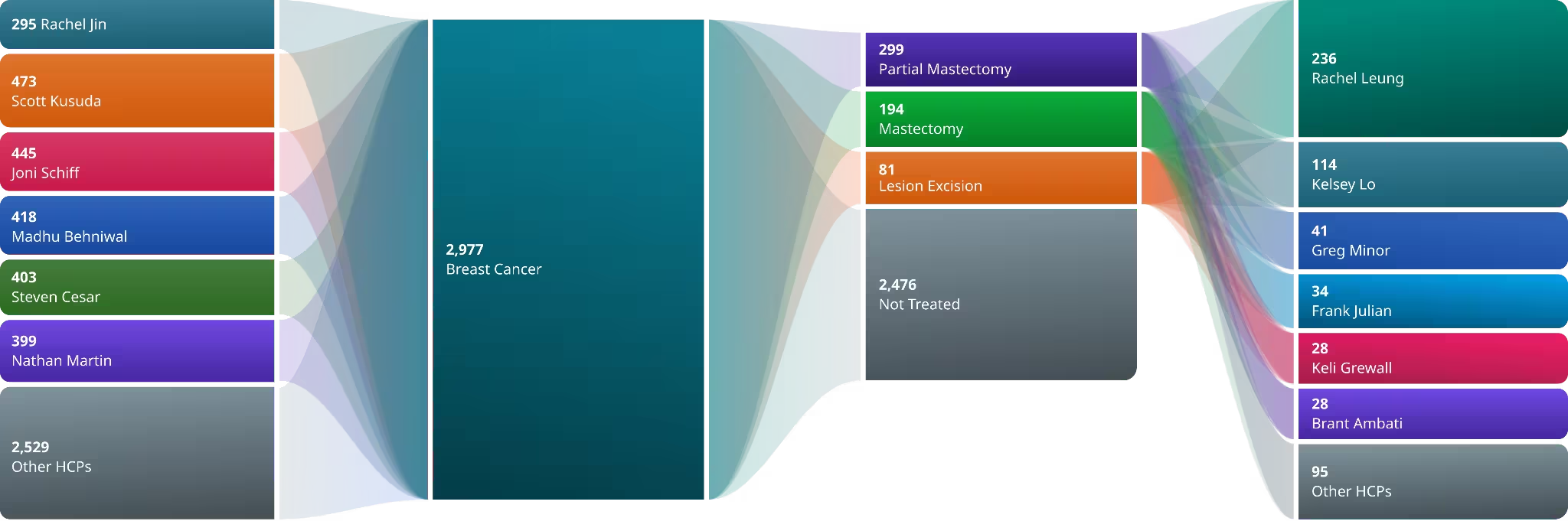
Procedure data identifies who is performing surgeries but says very little about the referral patterns driving those procedures. Longitudinal data shows how patients actually get there.
By mapping patient flow, it becomes possible to identify which primary care physicians (PCPs) are driving referrals for procedures using your products and which are sending patients elsewhere.
For specialists already using your product, this reveals a clear picture of referral dynamics: who the highest-volume upstream physicians are, how referrals are distributed, and where meaningful whitespace exists. Importantly, this goes beyond what’s captured in claims data. Referring NPIs are often incomplete or inconsistent, limiting their usefulness. Longitudinal analysis instead infers referral patterns from actual patient movement, capturing the real-world influence of conversations, reputation, and administrative routing.
The commercial implications are clear. If the majority of high-volume PCPs in a region are not referring to your customer, that represents a focused opportunity for education and engagement. Reps who bring this level of insight into upstream conversations position themselves differently. They’re not just introducing a product – they’re helping physicians understand and optimize their role within a broader care network.
The shift that changes everything
The most effective MedTech reps today aren’t just calling on the right physicians, they’re showing up with a deep understanding of the patient population behind them. They know where patients come from. Where they drop off. How outcomes vary. And which upstream dynamics are shaping demand.
Longitudinal data makes that possible. It adds a layer of commercial intelligence that transforms conversations and strengthens every business case.
Patient leakage. Intervention rates. Outcomes. Referral pathways. Four questions: each one enables more strategic conversations, stronger business cases, and better-informed territory decisions. And each one is only answerable when you can follow the patient journey from start to finish.
About Care Journeys from AcuityMD
Harness longitudinal patient-level data to find targets who see precise patient populations, convince targets to adopt your product, and connect upstream referrers to your existing doctors.