Why the MedTech commercial stack is changing
August 4, 2026
MedTech teams have more systems than ever, but still can’t see market shifts early enough to act. Here’s why healthcare market intelligence belongs inside governed data platforms like Snowflake.
MedTech organizations have never had more commercial data or more technology. CRM. ERP. Territory planning. Forecasting. BI dashboards. AI. Every year brings another platform designed to help commercial teams make better decisions.
Yet many teams still struggle to answer simple questions.
- Where is procedure demand growing?
- Which accounts are becoming more strategic?
- Which physicians are changing their behavior?
- Where should the sales team focus next?
The challenge isn't a lack of data. It's that commercial data lives across too many systems, and each one tells only part of the story.
The visibility problem
CRM, ERP, forecasting, and BI each capture a slice of the picture, but none were built to explain the market itself. That's especially true in MedTech, where physicians practice across multiple sites, hospitals merge, procedure codes evolve, and the same entity shows up differently across datasets. Reconciling all of that takes time, and by the time it's done, the opportunity may have already moved.
Market shifts almost always happen before revenue does: a health system starts adopting a new therapy, procedure volume climbs at a hospital, referral patterns shift toward a competitor. None of that shows up in CRM or forecasting for months. A rep can walk into an account visit with a CRM history that looks unchanged, while procedure volume, physician adoption, and referral patterns tell a very different story. That's the gap healthcare market intelligence is built to close.
Why the Encounters Data Mart on Snowflake matters
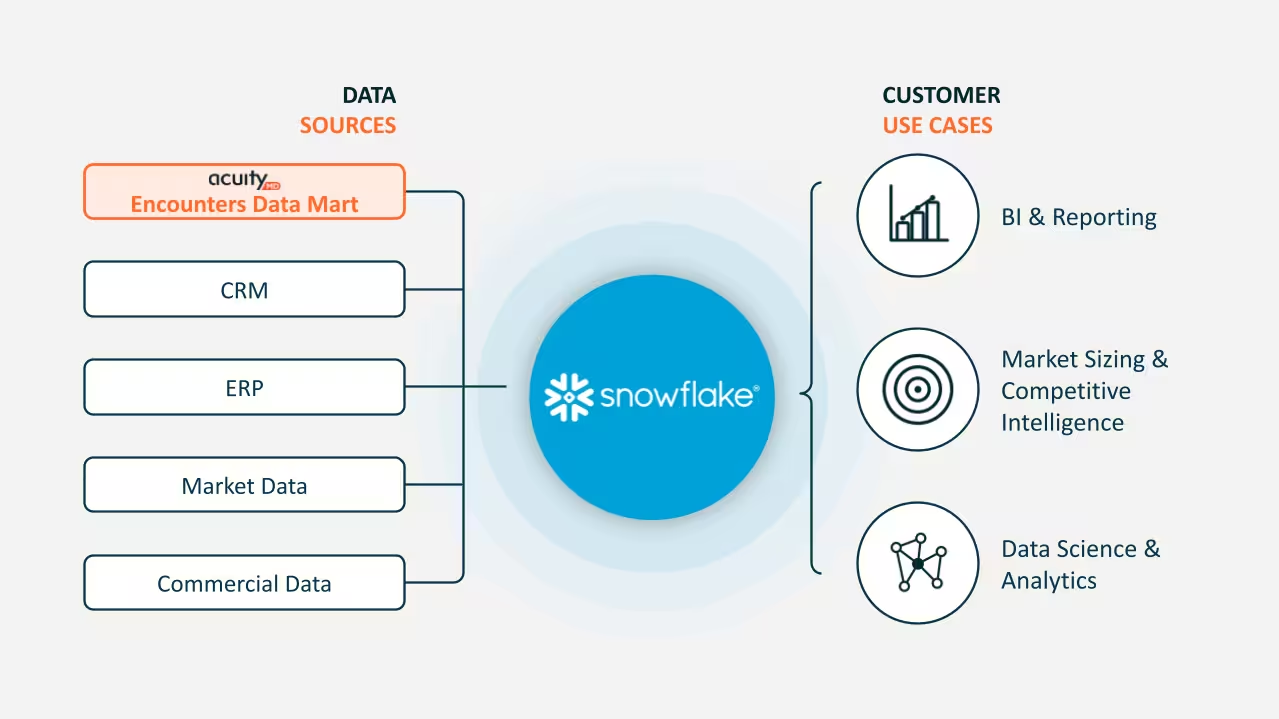
This is why more MedTech organizations are consolidating CRM, ERP, and healthcare market data into one environment instead of maintaining disconnected copies across teams, and why AcuityMD made its data natively available through the AcuityMD Encounters Data Mart on Snowflake.
Because it's delivered as a live dataset inside Snowflake, there's no file transfer, no pipeline to build, and no schema to maintain — teams install it once and get automatic updates from there. That matters as much to the data and analytics teams who own the warehouse as it does to the commercial leaders who use the output: forecasting models get sharper, territory prioritization can run on procedure demand instead of last year's revenue, and account insight can flow into Salesforce and other tools teams already use (see our integrations), all inside the governed environment IT already trusts.
It's good for the broader ecosystem, too: every MedTech team running commercial and procedure data side by side in Snowflake is a team getting more value out of an investment they've already made.
AI raises the stakes
AI can summarize, answer, and automate, but it can't fix fragmented or conflicting data underneath it. When physician identities don't match or market signals sit outside the warehouse, MedTech AI just produces faster answers from incomplete information. Connected, governed data is what makes it worth trusting — we go deeper on that in Why MedTech AI Needs More Than a Powerful Model.
The next generation of the MedTech commercial stack
CRM and ERP remain essential, but they're more valuable connected to trusted healthcare market intelligence. The organizations that build that connection will spot opportunities earlier and forecast with more confidence. As data platforms become central to commercial strategy, the winners won't be the ones with the most data — they'll be the ones who connect it well enough to act on it.